Why We Build Synaplan as Open Source — And Why CI Matters
AI is moving fast. New models launch every week, APIs change without warning, and companies are left wondering: can we actually trust the tools we are building on?
That is why we built Synaplan as a fully open-source platform — not just because transparency matters, but because it is the only way to give organisations real control over their AI stack.
What Synaplan Does
Synaplan sits between your team and the AI models on the market. Think of it as a management layer that lets you:
- Route requests to OpenAI, Anthropic, Google, Groq, Mistral, or local models via Ollama — from a single interface
- Switch models without changing your integration code
- Log every interaction with full audit trails for compliance
- Ground answers in your own documents via RAG
- Control costs with per-team budgets and routing policies
Instead of locking into one vendor, you keep every option open — and you can inspect every line of code that handles your data.
Developed in the Open
Synaplan is not "source available" with a restrictive licence. It is Apache 2.0 — fork it, deploy it, contribute to it. The entire development happens on GitHub:
Every pull request, every design decision, every bug fix is visible. If you want to know how your data flows through the system, you do not need to trust a sales deck — you read the code.
Why CI Matters for Enterprise AI
Open source alone is not enough. A project that breaks on every release or ships unpatched dependencies is a liability, not an asset.
That is why we invested heavily in a continuous integration (CI) pipeline that runs on every single commit:
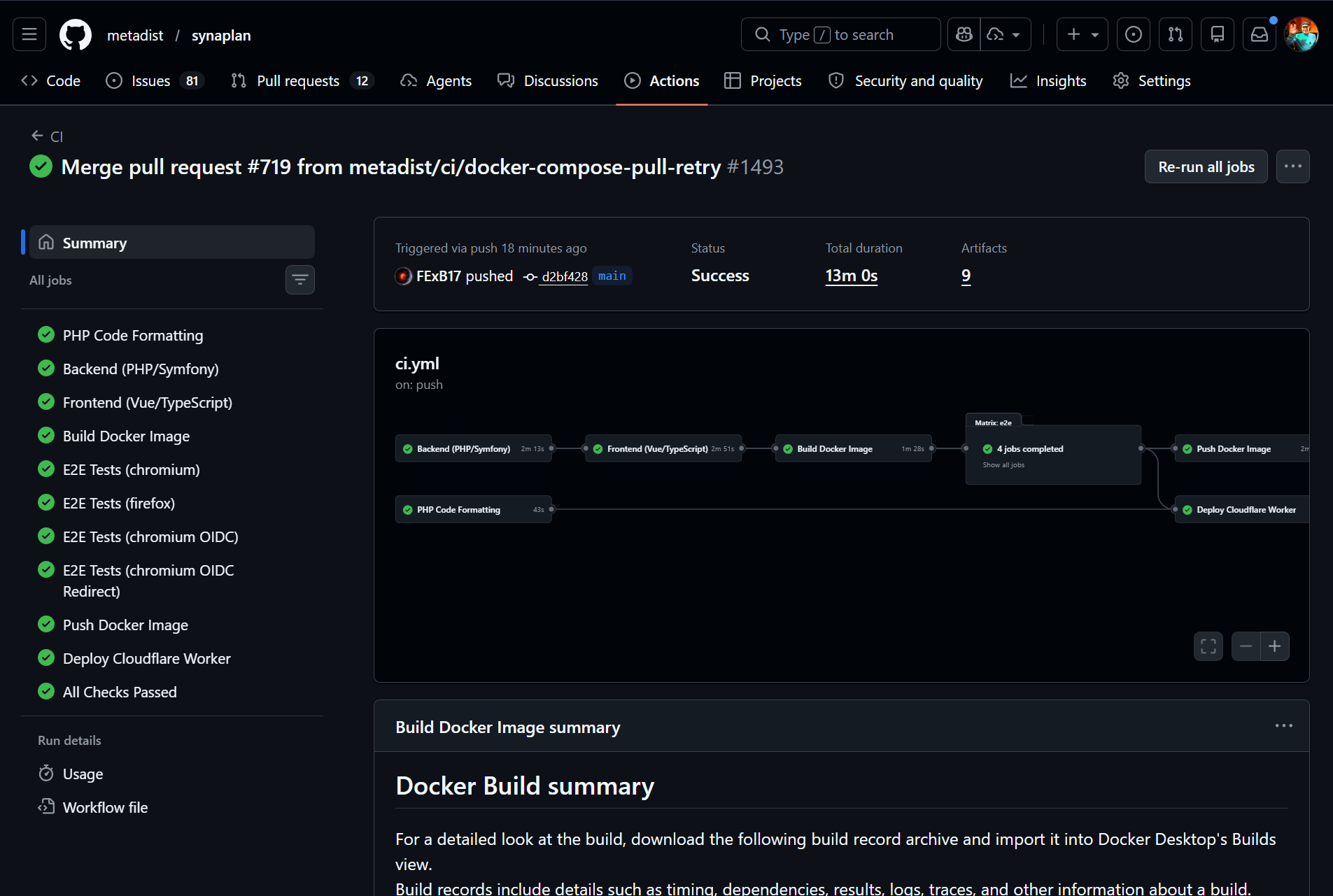
What our CI pipeline checks
- Backend linting — PSR-12 code style enforcement
- Static analysis — PHPStan catches type errors and logic bugs before they reach production
- Full test suite — PHPUnit tests covering API endpoints, services, and business logic
- Frontend linting — Prettier + ESLint for consistent TypeScript and Vue code
- Type checking — vue-tsc verifies every component and API client at build time
- Frontend tests — Vitest for unit and integration tests
Nothing gets merged unless every check passes. No exceptions.
Dependency monitoring
A modern platform depends on hundreds of libraries. Any one of them can introduce a security vulnerability. We handle this with:
- Renovate Bot — automatically opens pull requests when dependencies release new versions, so we stay current without manual tracking
- GitHub security scanning — flags known CVEs in our dependency tree
- Automated test runs on every update — Renovate PRs go through the same CI pipeline, so we catch breaking changes before merging
This means Synaplan does not silently accumulate outdated packages. Every dependency update is tested, reviewed, and traceable.
What This Means for Your Organisation
If you are evaluating AI platforms for your company, the CI pipeline is not a technical detail — it is a trust signal:
- Stability — every release is tested against the same rigorous checklist
- Security — vulnerabilities in third-party code are flagged and patched quickly
- Transparency — the entire build and test history is public on GitHub
- Predictability — you can review what changed between any two versions
For regulated industries, procurement teams, and IT security reviews, this level of openness is not a nice-to-have — it is a requirement.
Get Started
Synaplan is free to self-host and takes minutes to deploy:
git clone https://github.com/metadist/synaplan.git
cd synaplan
docker compose up -d
Or try the managed platform at web.synaplan.com — same code, no infrastructure to manage.
Synaplan is an open-source AI platform built by metadist GmbH in Düsseldorf, Germany. Apache 2.0 licensed, self-hosted or managed, with multi-model routing, RAG, and full audit trails.