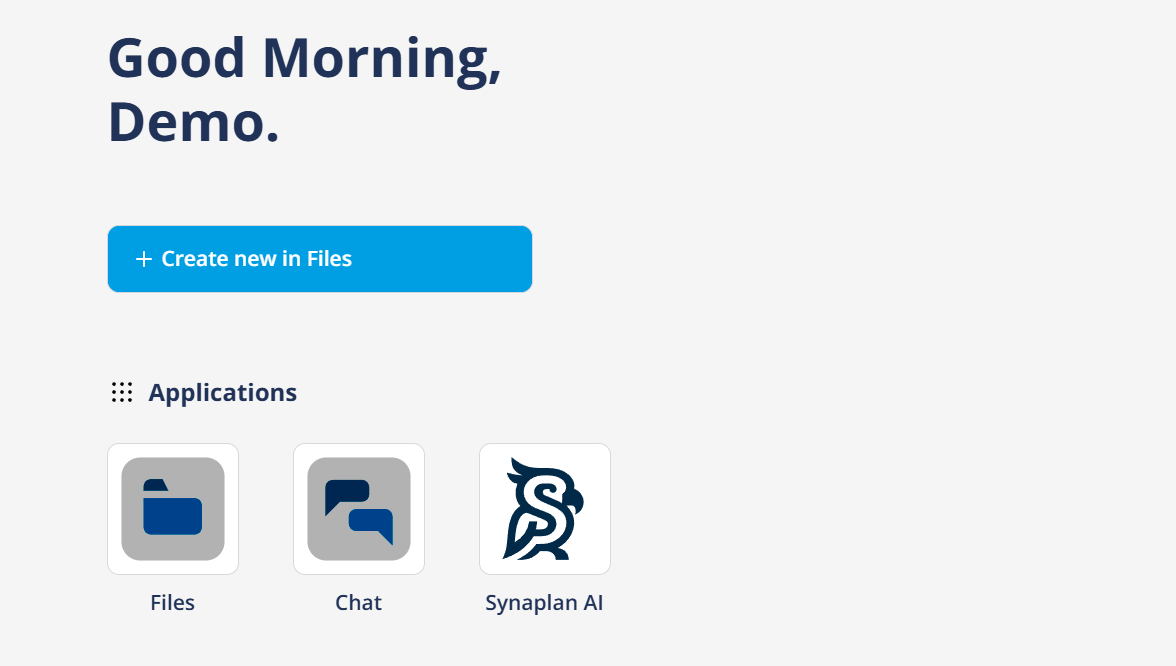
Synaplan × openDesk: AI with Real European Sovereignty
The AI conversation in Europe has shifted. A year ago, the question was "how do we use AI?" Today, serious organisations — and especially public institutions — are asking something much sharper: how do we use AI without handing our data, our workflows, and our future to a vendor outside our jurisdiction?
The answer, increasingly, is sovereign AI. And one of the clearest examples of that answer is coming together right now: Synaplan integrating with openDesk.
What openDesk Actually Is
openDesk — the Sovereign Workplace — is Europe's open-source answer to Microsoft 365 and Google Workspace. It is an integrated bundle put together under the guidance of Germany's Zentrum für Digitale Souveränität (ZenDiS) to give public administrations — and any organisation that cares about digital sovereignty — a complete, self-hostable office stack.
In a single package, openDesk brings together best-in-class open-source tools:
- Nextcloud for files, sharing and groupware
- Collabora Online for editing office documents in the browser
- OpenProject for project and task management
- Open-Xchange / OX for email and calendaring
- Element / Matrix for secure team chat
- Jitsi Meet for video conferencing
- Univention UCS for identity and access management
Everything is open source, everything runs on infrastructure the customer controls, and — crucially — none of it depends on a single non-European vendor.
For the first time in decades, a public administration in Germany or Switzerland can run its entire digital workplace without touching a US hyperscaler.
Why "Sovereignty" Isn't Just a Buzzword — In Plain Language
If you're not in IT, "digital sovereignty" can sound like paperwork. It isn't. Put simply:
- The data stays where the law says it has to stay. A Swiss cantonal administration's citizen records stay in Switzerland. A German municipality's internal documents stay under German law. No US Patriot Act exposure. No vendor lock-in.
- Decisions aren't taken 9,000 km away. If a global cloud provider changes pricing, terms, or availability tomorrow, your public services do not fall over.
- The source code is open. Any auditor, any security researcher, any citizen can look inside the software that processes public data.
That's what "sovereign" means in practice. Not paperwork. Control.
Where Synaplan Fits In
openDesk is an excellent sovereign workplace. What it does not include out of the box is AI — the modern layer that suggests answers, summarises documents, retrieves internal knowledge, and helps employees get work done in seconds instead of hours.
That is the gap Synaplan fills.
Synaplan is already running with public institutions in Switzerland and Germany on Kubernetes-based clouds. In plain language: it is deployed right now, today, on European sovereign infrastructure, helping real employees in public administrations use AI without any of their data leaving the country they work in.
Synaplan adds on top of openDesk:
- A chat interface for staff — like ChatGPT, but on your own servers
- Retrieval-Augmented Generation (RAG) across your organisation's own documents
- Multi-model routing — you decide whether a request goes to a local Ollama/vLLM model, a European provider, or a commercial model, per use case
- Full audit logs — every prompt and every answer is logged, so your data-protection officer can actually do their job
- Plugins for workflows like document classification (SortX) or custom assistants
Everything is open source. Everything is self-hostable. Everything speaks the same sovereignty language as openDesk.
What "Kubernetes-Based Cloud" Means If You're Not a Techie
You will hear "Kubernetes" a lot in this space. Don't worry — the idea is simple.
Kubernetes is basically a conductor for servers. Instead of one big computer running your software, Kubernetes spreads the work across many smaller computers, moves things around when one fails, and scales up when more users arrive. It has become the standard way modern cloud software is deployed.
openDesk runs on Kubernetes. The sovereign data centres in Switzerland and Germany where openDesk is hosted run on Kubernetes. So — for Synaplan to slot neatly into this world — Synaplan also has to run on Kubernetes.
It does. And we have made that easy.
Public Helm Charts: Deploy Synaplan the Sovereign Way
We publish our Helm charts — the recipes that tell Kubernetes how to install and run Synaplan — as open source, for everyone to use and audit:
👉 github.com/metadist/synaplan-charts
That means:
- A sovereign cloud provider in Bern, Berlin or Bremen can deploy Synaplan next to openDesk in a handful of commands.
- A public administration's own Kubernetes team can self-host everything without asking us for a custom installer.
- Everything is inspectable, forkable and auditable — exactly the values openDesk stands for.
If you already operate openDesk, adding Synaplan does not mean bringing in a new vendor platform. It means pulling one more chart into the cluster you already run.
What We're Building Next — With European Partners
This integration is not a one-off. The Synaplan development team is actively working on:
- Deeper openDesk integration — Synaplan appearing as a native part of the openDesk portal, not as a separate tab
- Nextcloud document sync — ask questions against the files that already live in your sovereign workplace, with the same permissions as in Nextcloud
- SSO via UCS / Keycloak — one login for openDesk and Synaplan, the way public administrations expect it
- Support through certified European partners — integrators and system houses in Germany, Switzerland, Austria and beyond who can roll Synaplan + openDesk into existing sovereign clouds
We are actively talking to partners across Europe who already deliver openDesk, Nextcloud and sovereign-infrastructure projects. If that sounds like you — or if that is the stack you want in your organisation — get in touch.
Sovereign AI Isn't a Roadmap Promise Any More
This is the part worth repeating, because it matters: sovereign AI is no longer a roadmap slide. It is deployed. It is in production. It is running on Kubernetes in Swiss and German data centres, next to openDesk, helping public employees do their jobs.
For years, "we want AI, but we cannot send our data to a US cloud" sat on the list of apparently unsolvable problems. It turns out it is solvable. openDesk solves the workplace side. Synaplan solves the AI side. Together, they look a lot like the future European organisations have been waiting for.
Open source. Self-hosted. On your own Kubernetes. With full AI on top.
That is sovereignty that actually works.